Lady Frances Derwent
Why Didn't They Ask EvansLady Frances Derwent enters the story as a familiar presence in Bobby Jones’s life and soon becomes an active participant in the investigation. Her conversation moves easily from teasing social commentary to close attention to evidence; when access to a household seems difficult, she does not wait for an invitation but devises a staged accident to get inside. The contrast makes her more than a witty companion: she is an energetic planner who can make performance serve practical ends.
Identity and Introduction
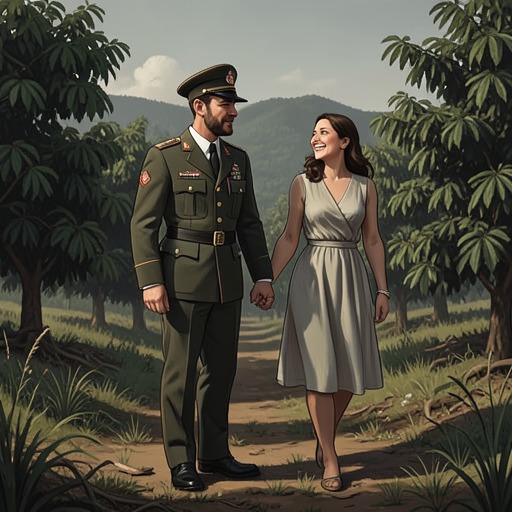
Lady Frances, whom Bobby calls Frankie, first appears in a first-class railway carriage, dressed in a red skirt, short green jacket, and bright blue beret, smoking a cigarette. The narrator describes her dark, sorrowful eyes and puckered expression, but also makes clear that she is attractive. This distinctive, somewhat comic portrait gives way quickly to her ease with Bobby: he breaks off an apology when he recognizes her, and they greet each other as old friends who have not met for some time.
Their first exchange establishes a teasing familiarity. When Bobby’s ticket is the wrong colour, Frankie offers to pay the difference; his mock indignation at being paid for by a woman prompts her to joke about what men are good for these days. Neither treats the moment as a real quarrel. Their banter instead shows that Frankie is comfortable taking the initiative, and that Bobby meets her with good humour rather than formality.
Social Outlook and Friendship with Bobby
Frankie explains that her father’s habit of tipping everyone five shillings whenever he travels helps account for the favourable treatment they receive. The detail connects her family’s resources to an ordinary social encounter, while her account of life at home is decidedly less admiring. She complains of mouldy parents, bathrooms in poor condition, little to do, and few visitors willing to travel to the country. Her question of what a girl is supposed to do gives her restlessness a concrete setting: she presents country life as constrained by both family and circumstance.
She has also just attended a party that, in her view, was not bad so much as excessively like every other party. Her complaint is wry rather than a report of any particular incident, and the conversation gives no further account of the gathering. Instead, the scene establishes her impatience with monotonous social routines. Bobby recognizes the problem, and their talk has the ease of friends who can exchange complaints without ceremony.
That ease survives a sharper disagreement later. Frankie strongly objects to Bobby’s favourable view of Amelia Cayman’s photograph, arguing that retouching has made it misleading and that the woman is unattractive. Bobby defends his opinion, and their argument briefly turns heated; Frankie calls his response ridiculous and rebukes him for quarrelling over the woman. She then lets her temper subside and proposes a round of golf. They set off amicably, talking about slicing, pulling, and improving a chip shot. The quick transition from dispute to shared recreation shows that disagreement does not undo their companionship.
The Photograph and the Investigation
The argument acquires a more serious significance when Bobby later shows Frankie a newspaper reproduction captioned as the portrait found on the dead man and used to identify him as Amelia Cayman’s brother. Frankie recognizes it as the picture she had criticized. Bobby then points out the discrepancy: this was not the photograph he had put back in the dead man’s pocket. The disagreement has therefore brought them back to a physical clue, and the image’s identity becomes more important than either person’s original judgment of its appearance.
Frankie follows the implication with him. They consider whether there could have been two photographs, immediately noting that this is unlikely, and then pause over the alternative. The scene does not have Frankie announce a solution; its force lies in the shared recognition that the evidence no longer fits a simple account. Her earlier insistence that the image was touched up gives the comparison a personal continuity, while the mismatch turns their casual talk about a photograph into a question about how the dead man was identified.
The Plan for Merroway Court
Frankie’s clearest display of initiative comes when she tells Bobby that she is pursuing a Bassington-ffrench who lives at Merroway Court in the village of Staverley, Hampshire. She explains that the house belongs to his brother and that the household includes the brother’s wife. Having already reconnoitred the area, she judges that strangers arriving to stay in a small village would be conspicuous. The difficulty is not simply reaching the house; it is finding a way to enter without drawing attention to themselves.
Her answer is to manufacture a credible reason for being taken in. Frankie proposes driving recklessly into the wall near Merroway Court’s gates, wrecking the car and sustaining injuries short of serious bodily harm. She is to be carried into the house with concussion and shock, and then declared too vulnerable to move for two or three days. The plan depends on a performance of helplessness, but it is designed and directed by Frankie herself.
She builds a second role into the scheme for Dr George Arbuthnot. He is to be passing in another car, identify himself as a doctor, take charge of the scene, and insist on examining her inside the house. Frankie anticipates the risk of a local doctor or another bystander interfering, so the proposed examination gives her ally authority over what happens next. Bobby is assigned the practical task of selling them a second car. These details make the plan a coordinated operation rather than a vague hope: a staged crash creates the emergency, the doctor controls its interpretation, and the household becomes their point of access.
Narrative Role
In the evidence presented here, Frankie’s role develops from Bobby’s old friend and witty conversational partner into a collaborator capable of shaping the investigation’s next move. The photograph scene links her sharp eye and earlier disagreement to a problem of mistaken identification; the Merroway Court plan shows her applying reconnaissance, social knowledge, and improvisation to the obstacle of entering a guarded household. The proposed crash is still a plan at this point, not an accomplished event. Its importance lies in what it reveals about Frankie: she understands that appearances can obstruct inquiry, but also that a convincing appearance can open a door.